Peace, love and joy are common greetings this time of year and ones I always aspire to demonstrate. I visited Laurel Hill Cemetery this fall and found it to be an amazing and peaceful place. A place where loved ones of the deceased as well as the members of the surrounding community reflect, remember and commune with nature.
Located along the Schuylkill River not far from center city Philadelphia, Laurel Hill serves as the final resting place for many.Gregg Tepper, Senior Horticulturalist; Aaron Greenberg, Arboretum Manager; and Jo Cosgrave, Horticulturalist (not pictured) spent the better part of a day with us and provided a comprehensive tour.Visitors see monuments for miles surrounded by majestic trees.Seating areas invite visitors to pause and remember.Shade trees add to the peaceful setting and provide the perfect place for reflection.
Laurel Hill is a very special cemetery. It’s historic, yet modern, an arboretum and more. The arboretum staff do a stellar job of maintaining the property and use nearly maintenance-free plants to ensure lasting appeal. Drought tolerant plants and other gorgeous specimens provide a great alternative to plastic or silk flowers which are strictly prohibited.
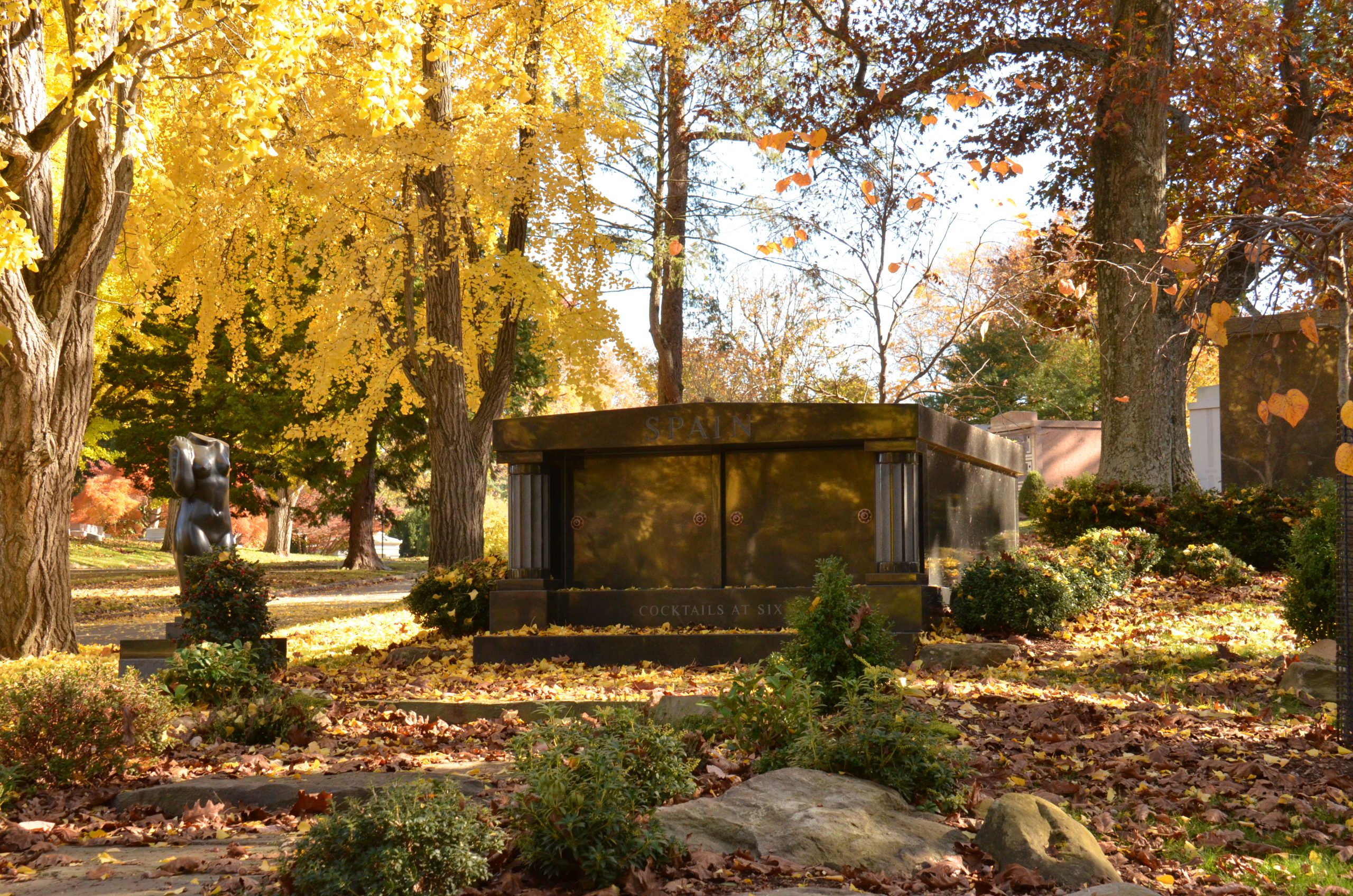
Sedums and other drought tolerant plants grow in challenging spaces like these cradle graves with stone surrounding them.Pellaea atropurpurea (Purple cliffbrake fern) grows happily in the stone archways.6000 specimen trees and shrubs and over 700 unique species and cultivars grow here along with some state champion trees.I loved this allée of Gingko trees.During my fall visit, this Camellia was in full bloom.Uniquely colored roses softened the many stone monuments.This climbing rose graced a nearby trellis at Laurel Hill East Cemetery.Climbing aster (Ampelaster carolinianus) added great color to the fall landscape.Wealthy people are buried in millionaires’ row which has a spectacular view.Some of the millionaires’ names are listed on this marker.The owner of this gravesite engraved ‘Cocktails at Six’ is on their monument to highlight a daily routine.Architectural masterpieces appeared around every corner, like this Art Deco inspired mausoleum.Certain monuments looked broken and ruined, showing in stone how loved ones felt regarding the passing of their beloved.
Laurel Hill has evolved with the times. They now offer a green cemetery area where un-embalmed bodies are buried in caskets made of wicker or similar materials that rapidly decompose. When the reserved active burial area is full, native plants and trees cover the bare earth. As an echo of human life, plants mature, and shade trees transform the sunny meadow into a forest over time.
The green burial area starts out as meadow and eventually becomes a forest.Meadow plants include Asters and Asclepias. Mother Nature uses seeds left to ripen to create new life.Eryngium leavenworthii shows off its purple sheen in the meadow.Granite slabs engraved with the names of those buried in the green area take the place of gravestones.
While some may find the thought of visiting a cemetery unappealing or depressing, I encourage you to change your mindset. Cemeteries can be magical spaces, especially when they house an amazing assortment of trees, shrubs and perennials planted artfully to sooth the soul.
4 Responses
Jeanette Hanna-Ruiz
I love this post. Having been born in the U.S. compared to part of the culture I grew up in (Latin American) we always talk about death as a natural part of life. Like you, I often go to cemeteries just to visit and see when I am traveling. This year I went to the amazing cemetery in St. Tropez, France. I am not sure I can imagine a more serene and peaceful final resting place. The graves an had different plants that were indigenous to the area. The graves all looked out at the sea, as such the native trees provided just the right amount of shade from the Mediterranean sun. So thank you for posting this. Cemeteries are an excellent place to connect with a local communities history and see another way plants and trees can be used to enhance the atmosphere. Great topic!
Thanks for your comments and unique perspective Jeanette – much appreciated!
Gregg Tepper
Thank you Carol for visiting with us and showcasing Laurel Hill’s many horticultural offerings here in your blog! It was a blast to walk around with you and Andy and show you what we’ve been up to.
You did a fabulous job featuring the many plants, shrubs and trees in our Arboretum’s living collection and add to that the varied monuments that comprise our cemetery’s vast collection of unique historic sculpture. Well done! Please come see us again in April to experience the spring flowering trees and shrubs.
All the best,
Gregg




I love this post. Having been born in the U.S. compared to part of the culture I grew up in (Latin American) we always talk about death as a natural part of life. Like you, I often go to cemeteries just to visit and see when I am traveling. This year I went to the amazing cemetery in St. Tropez, France. I am not sure I can imagine a more serene and peaceful final resting place. The graves an had different plants that were indigenous to the area. The graves all looked out at the sea, as such the native trees provided just the right amount of shade from the Mediterranean sun. So thank you for posting this. Cemeteries are an excellent place to connect with a local communities history and see another way plants and trees can be used to enhance the atmosphere. Great topic!
Thanks for your comments and unique perspective Jeanette – much appreciated!
Thank you Carol for visiting with us and showcasing Laurel Hill’s many horticultural offerings here in your blog! It was a blast to walk around with you and Andy and show you what we’ve been up to.
You did a fabulous job featuring the many plants, shrubs and trees in our Arboretum’s living collection and add to that the varied monuments that comprise our cemetery’s vast collection of unique historic sculpture. Well done! Please come see us again in April to experience the spring flowering trees and shrubs.
All the best,
Gregg
Thank you Gregg – the tour was inspiring! I will mark my calendar for April for another visit!