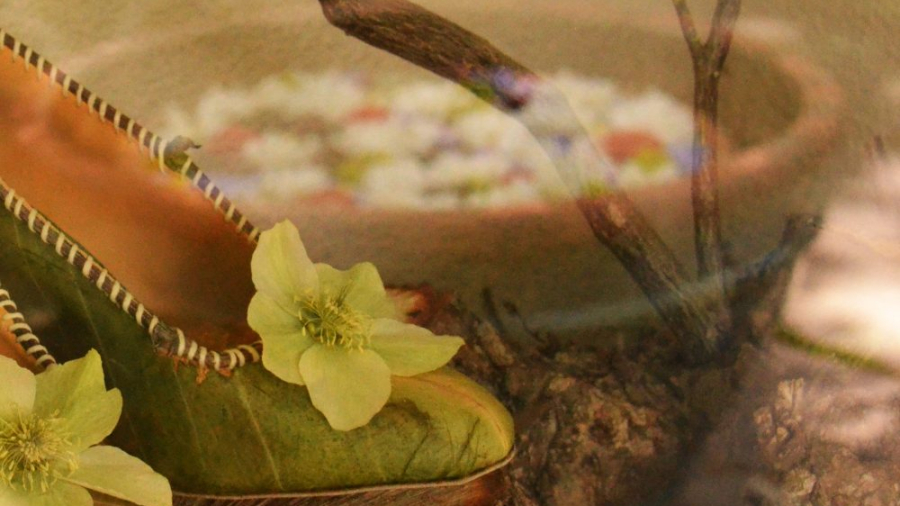
shoe made of natural materials with hellebore flower

Transforming Nature into Art

My friend Lenny is an artist through and through. Initially inspired by the fashion industry, he spent a year in England in the mid to late 80s where he studied shoe making at the prestigious Cordwainer school and then served as an apprentice. After returning to the US, Lenny tried to find employment in the shoe industry to no avail. But at this time, he embarked on a career in horticulture becoming inspired by nature and gardens while keeping his shoemaking on the back burner.

As it often happens in life, serendipity intervened. Lenny had the opportunity to utilize natural materials from the gardens where he lived and worked to create an ephemeral piece for an art exhibit – a pair of shoes. Since then, he has made over 50 pairs of shoes.
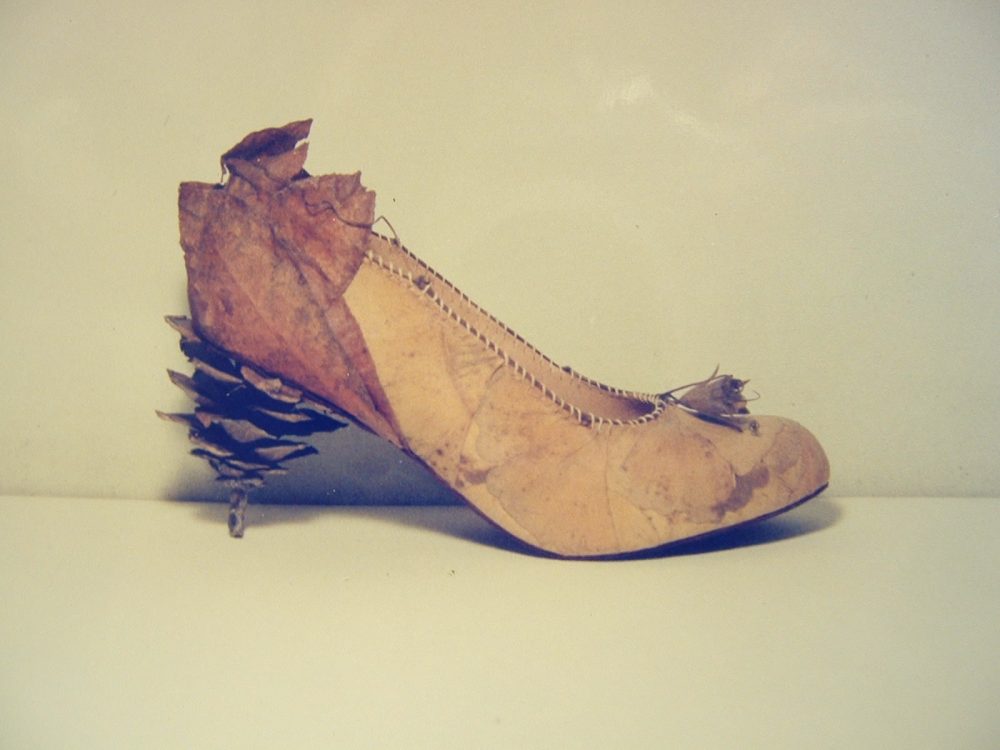
Pair of shoes made from natural materials - gingko in this case
The first pair of shoes Lenny made constructed of Gingko leaves with a pinecone heel.

I was first introduced to Lenny’s work at Winterthur during their yuletide exhibit in December of 2023 where I saw his art on display and was wowed by his attention to detail and composition. Currently Lenny is working with Chanticleer to harvest materials from their garden (with permission of course) to create living art that will be on display in a case on the patio of the main house. Using seasonal materials from the garden, Lenny will construct five pairs of shoes that will be on display from the end of April to July. An additional five pairs will be on display from the end of July through October. In addition to sharing his work with visitors, Lenny will educate the public about plants featured in a garden during exhibition-related programs.

shoes made of natural materials
The shoes Lenny made for the Winterthur Yuletide exhibit.

I tagged along on Lenny’s trip to Chanticleer to learn what inspires him and what materials he finds the most useful. I loved hearing that Lenny was intrigued by the story of the original owners, the Rosengarten’s, and sought to create a pair of women’s shoes and also a man’s slipper in honor of them.

I observed Lenny selecting large leaves with interesting veining or patterns. As you can imagine, he needs a number of leaves to cover the leather form. At the same time, he didn’t want to make his harvesting apparent, so he collected carefully. For details and embellishments, he often uses seed heads or vines. To simulate a brocade, he’ll use an interesting conifer. He often turns leaves upside down when applying them to the form. Bark, branches or cones become heels. Lenny explained the difficulty in getting the patterns to match from shoe to shoe, since every leaf or branch is slightly different.
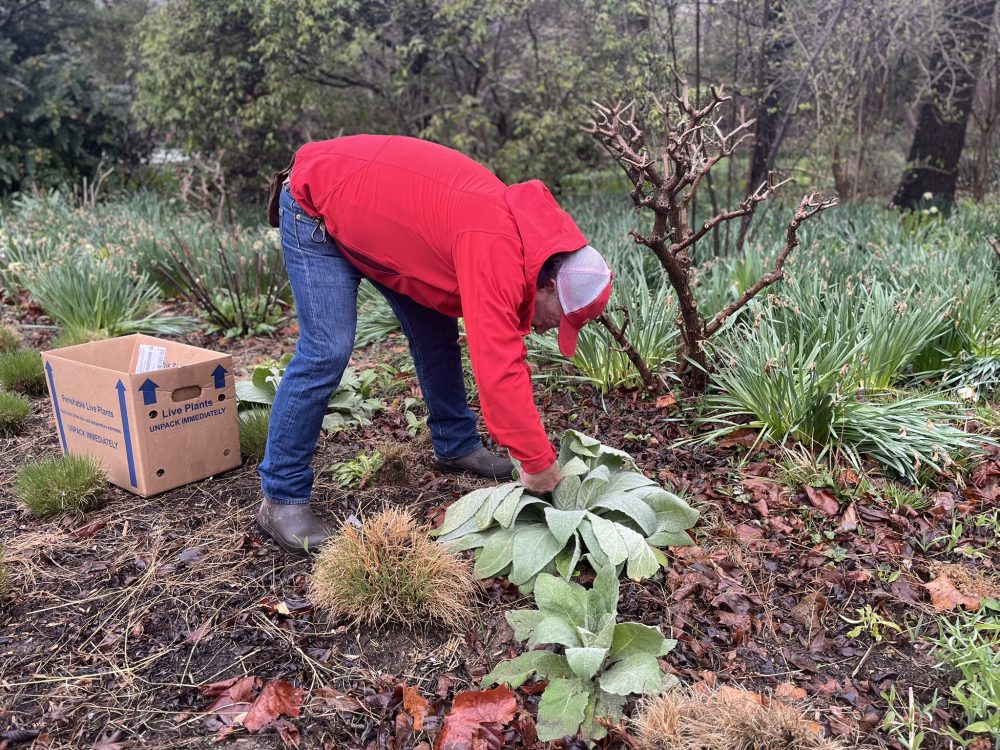
Man harvesting leaves from plant
Lenny carefully harvested materials to use for his shoemaking.
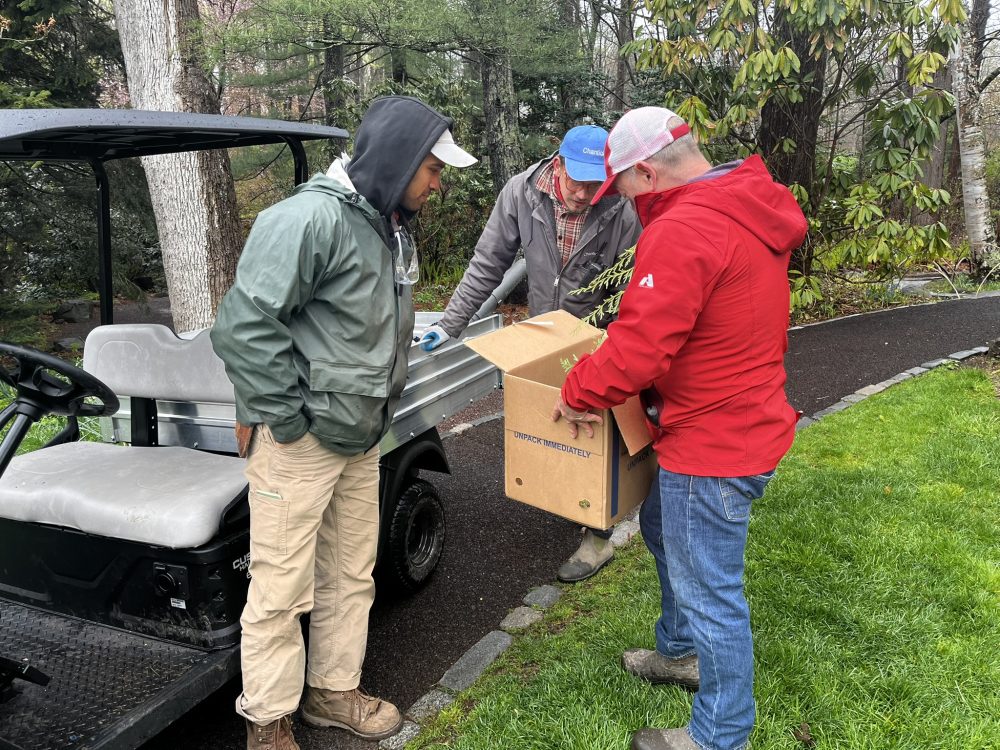
Man showing workers the harvested materials in a box
Chanticleer staff members were excited about the project and examined Lenny’s harvest with interest.
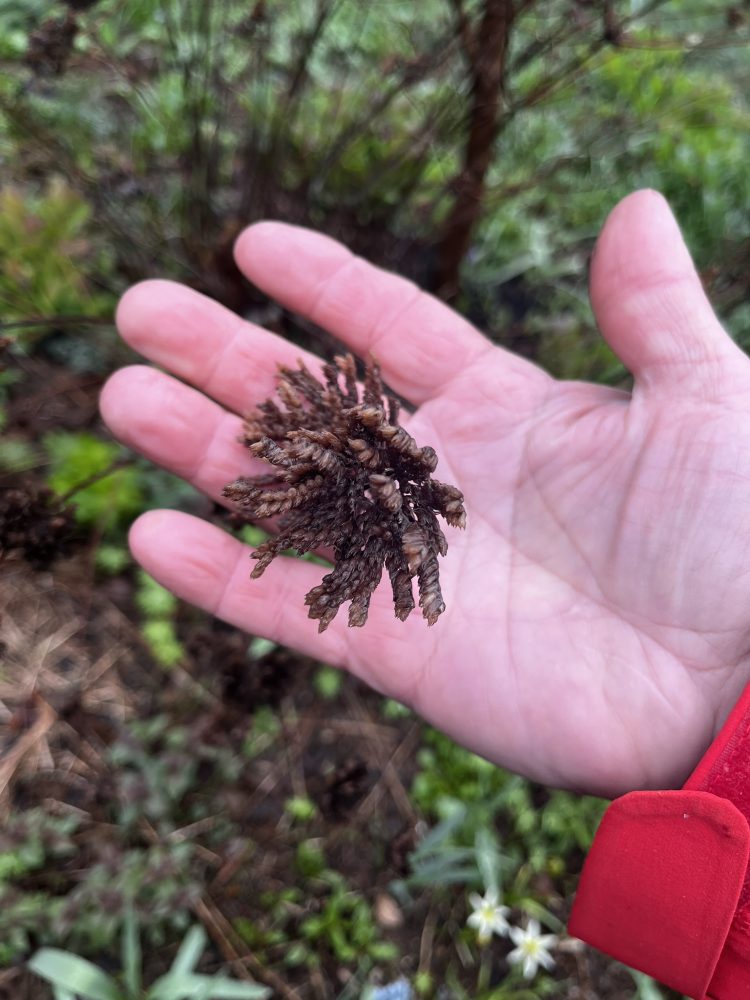
Hand holding a seed head from a flower
Lenny sought out unique embellishments like seedheads to use for his project.
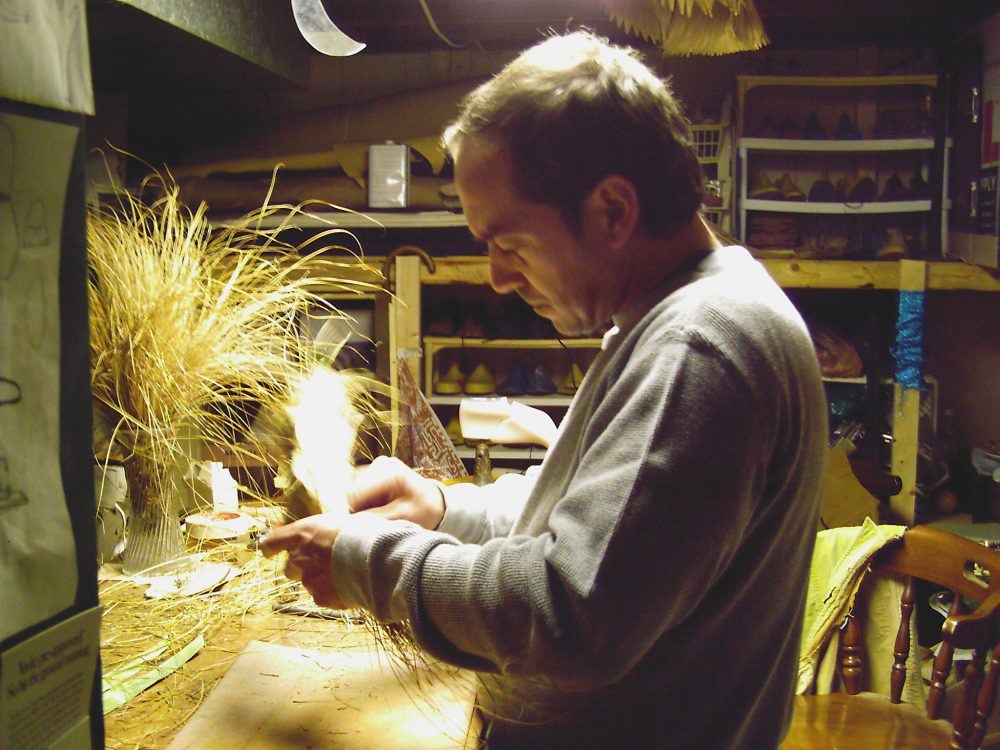
Man making shoes
The artist at work.
shoe form with leather
The shoe form Lenny uses as a foundation for his art.
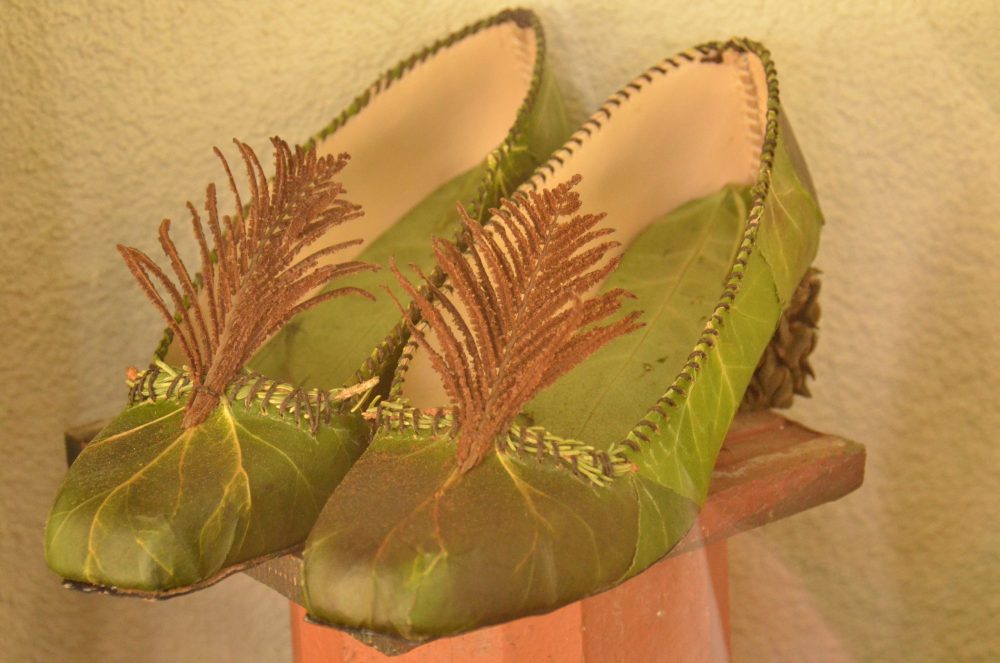
Shoes made of natural materials with fern fronds
One of the pairs on display at Chanticleer made of locally collected material.
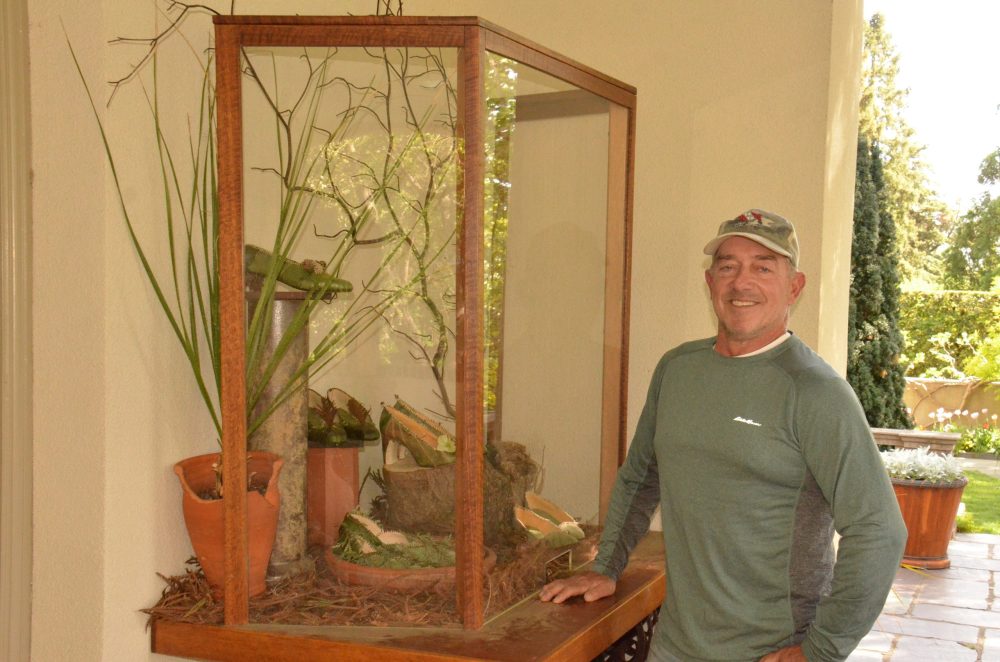
Lenny with case of hand made shoes
Lenny standing next to the case where his shoes are on display.

Seeing the shoes on display and witnessing the process of their creation is a gift; I highly recommend you visit Chanticleer to see the garden and the art Lenny created from it. I hope all the other public gardens in America’s garden capital take advantage of Lenny’s talents and commission him to create shoes made from materials on site. And if you’re wanting a pair for yourself, you can reach out to Lenny directly on Instagram @lennywilson.  As you can imagine, the shoes won’t last forever. But that’s another thing that makes them special. Just like with our gardens, plants come and go. We cherish them while they exist and are forever touched by their beauty.
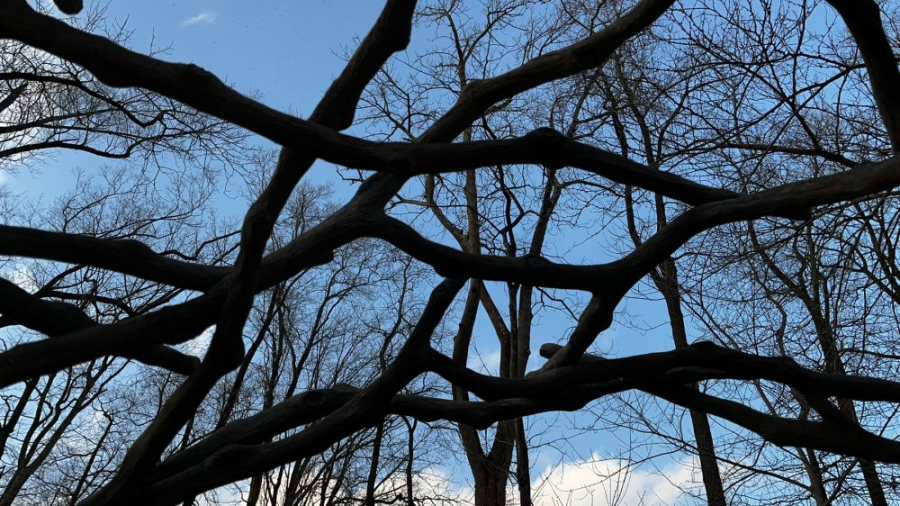
Faux bois branches against real branches and blue sky

The Love Shack Reinvented

I’ve been visiting gardens for many years and have always been intrigued by structures made of natural materials. In particular, I adore a nest, playhouse or shelter made of branches. This passion for functional art made of branches inspired me to work with my partner Andy to build a sitting area in my garden that we affectionately called “The Love Shack.”

garden seating area made out of woven branches
The original Love Shack was a great spot to relax in the garden and was adorned with Clematis montana.

For a few years this sitting area provided garden visitors with a great perch from which to view the garden. But then nature happened. The branches and harvested vines we had used to construct our masterpiece began to weaken and break. By the end of last year, if you wanted to sit in The Love Shack, you had to limbo to get in.

It was time. Time to reinvent. Time to reimagine. I thought about rebuilding the structure in exactly the same way but realized that would be a never-ending process. If I chose the same route, I would need to find a source for invasive vines to harvest and rebuild every few years. The older I get, the less I want more physical work to do so the idea of repeating history over and over again seemed daunting.

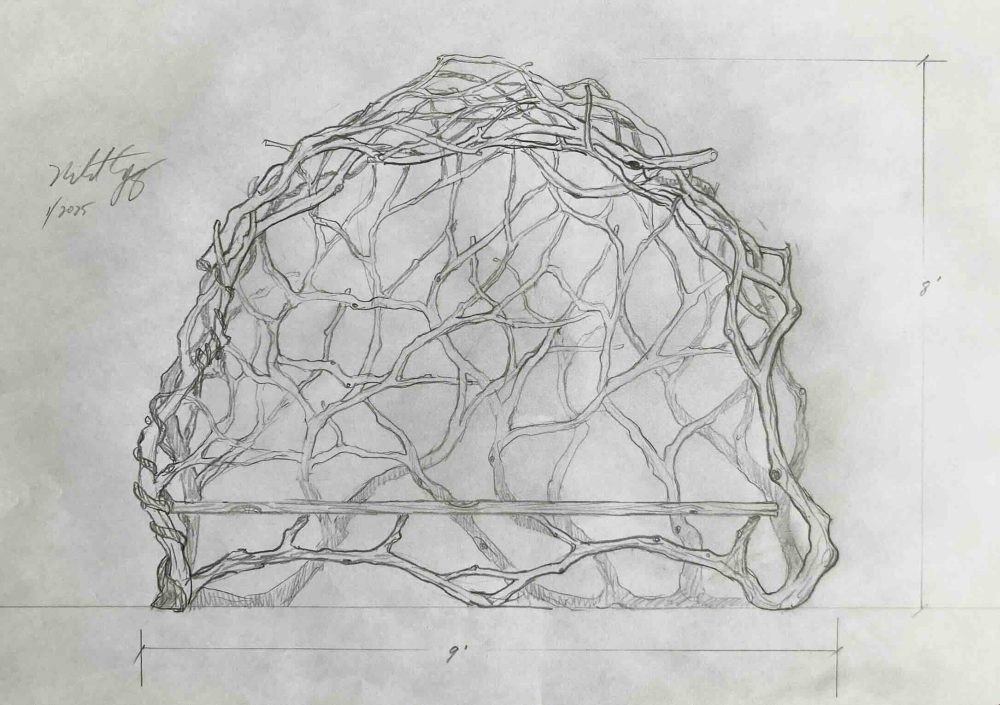
Fortunately, while I was pondering a solution to my quandary, a friend sent me a photo of a faux bois arbor constructed by artist Michael Fogg. Michael transitioned from working with real wood as a carpenter, to working with rebar and concrete. Now he utilizes his talents to create permanent structures that look like branches and slabs of wood.

I reached out to Michael and sent him some photos of the original sitting area Andy and I had built. He drove down from Connecticut to see my property, to look at the original piece and to determine if the project was something he wanted to take on. Luckily, he said yes, and we began the process of designing a replacement for the original Love Shack. Michael’s detailed drawing became the template for the final design.

faux bois art drawing showing design and dimensions
Michael Fogg’s drawing showed his vision for the reinvented structure.

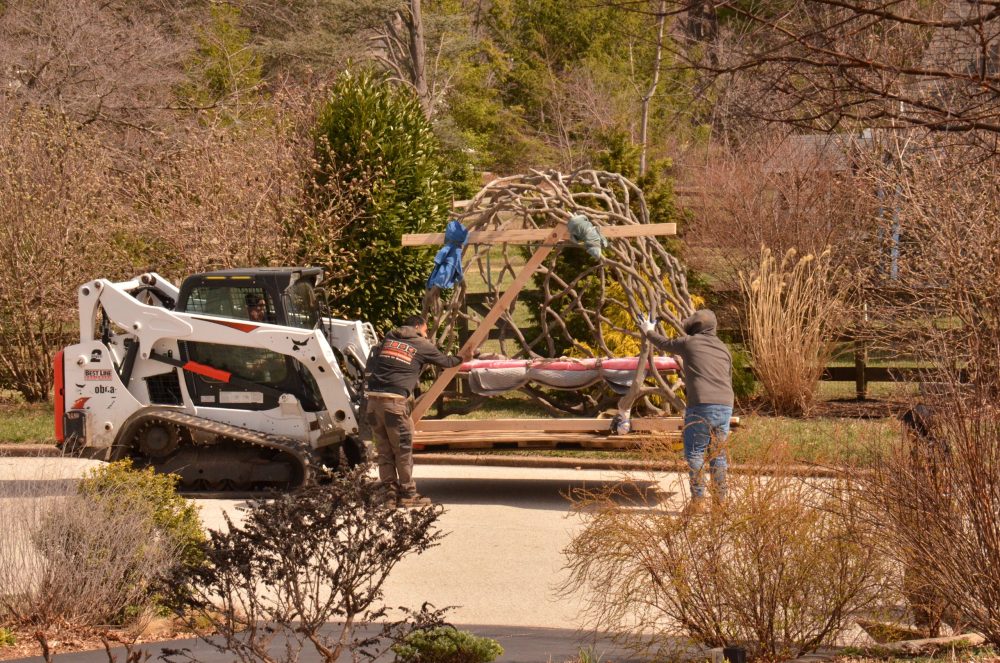
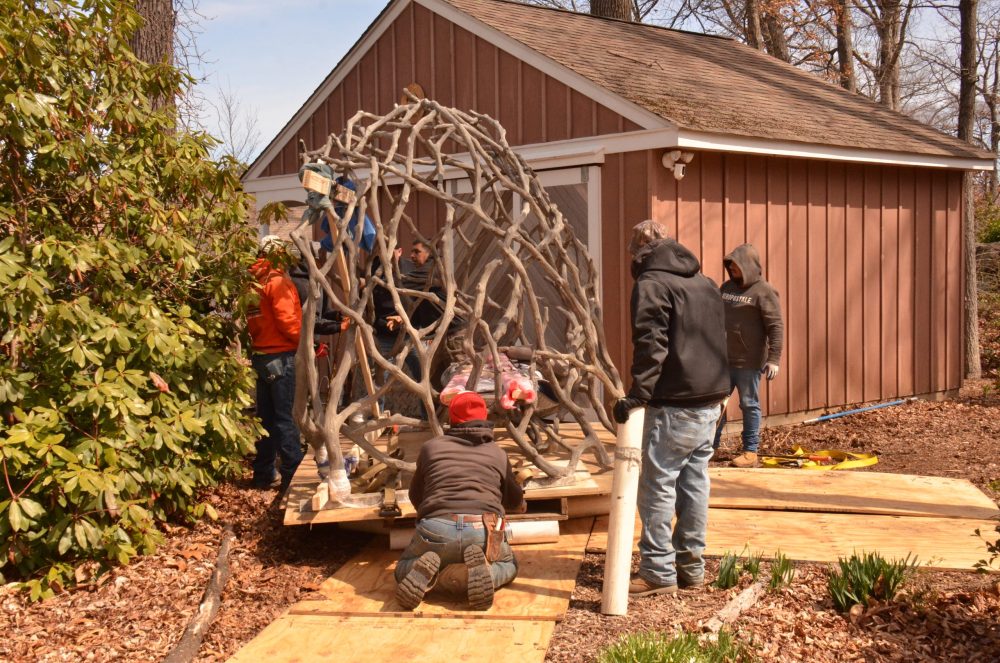
Over the winter Michael completed the masterpiece. Traveling to Pennsylvania from Connecticut with the finished sculpture in tow was no small task. But Michael made it safely and my crew of hired help and friends was ready to assist with the move.

faux bois sculpture being loaded on pallet
A custom platform transported the sculpture through the garden.
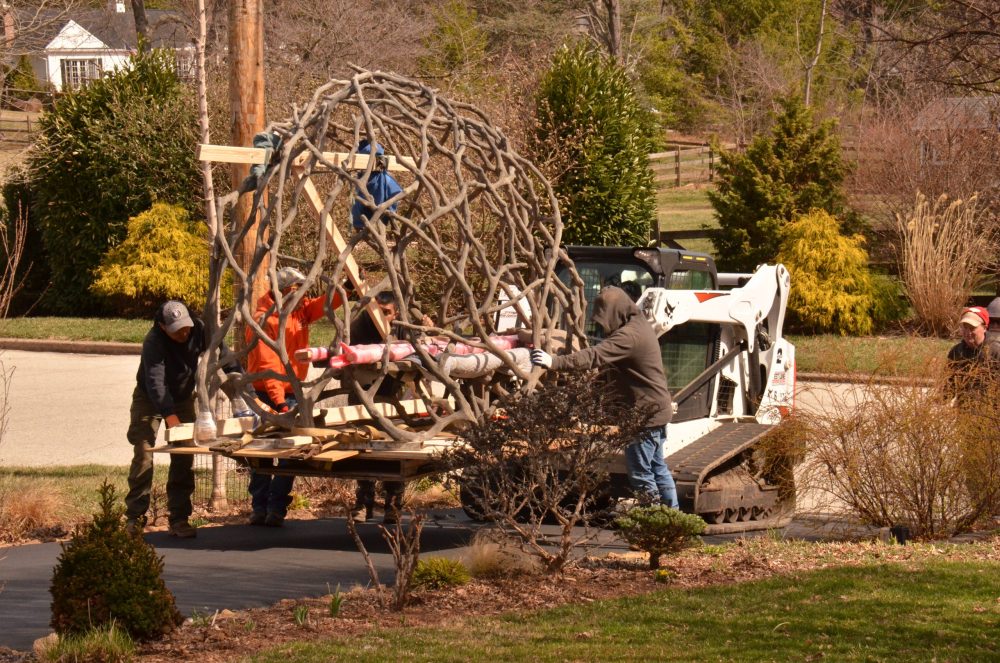
moving faux bois sculpture up the driveway on a skidsteer
The team carefully moved up the driveway towards the back of the property.
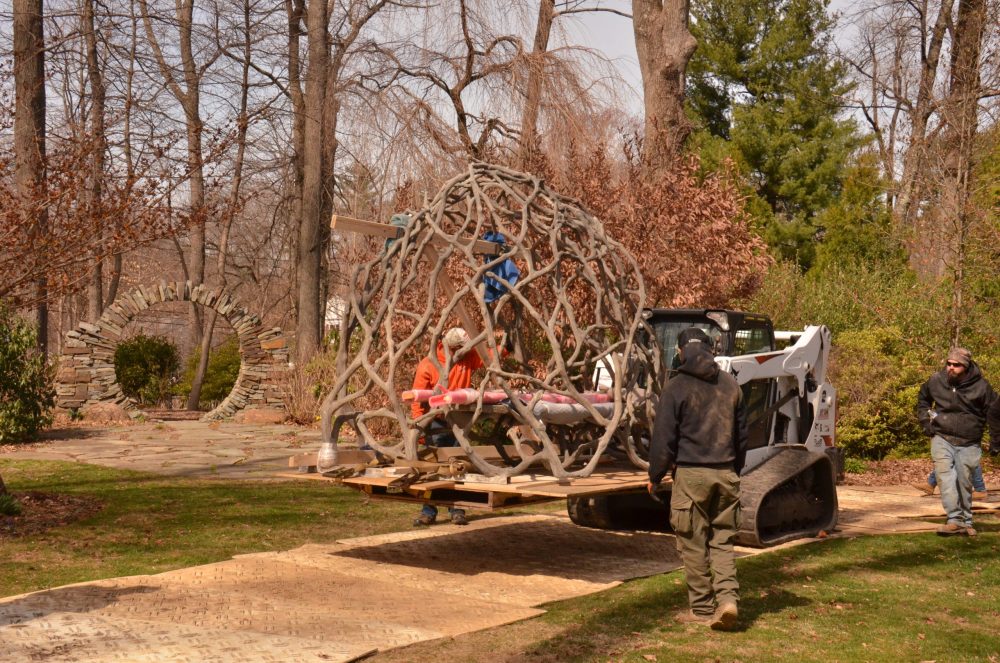
the faux bois sculpture passes by the stone moon gate
I hope my new garden art enjoyed saying hello to the existing moon gate as it passed by.
moving faux bois sculpture past shed
The area by my shed was a tight spot that required special navigation.
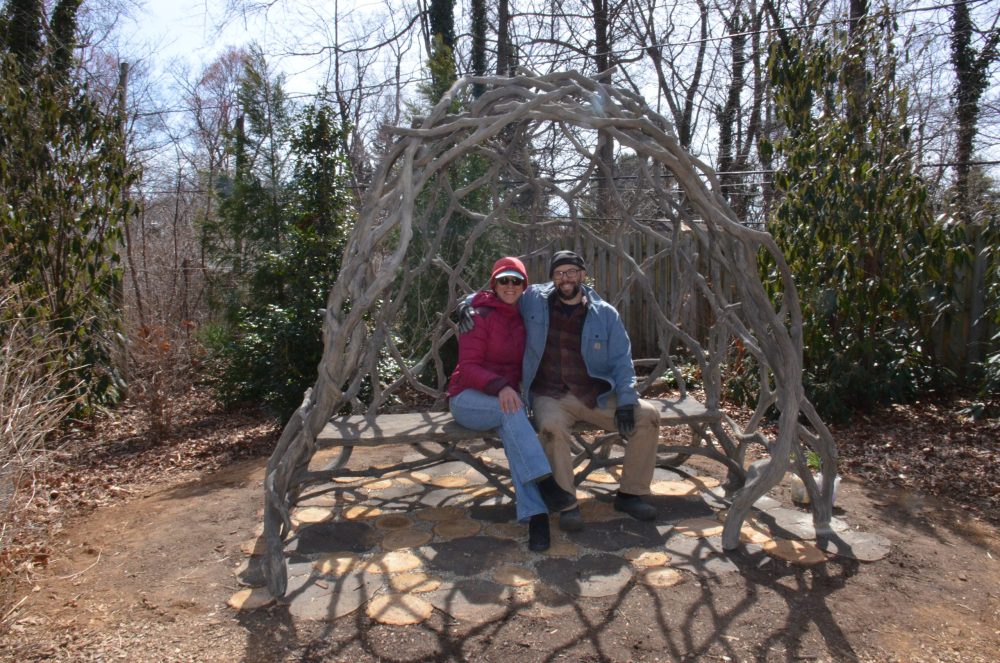
faux bois sculpture in place with man and woman sitting on bench
I’m pictured here with the artist Michael Fogg.
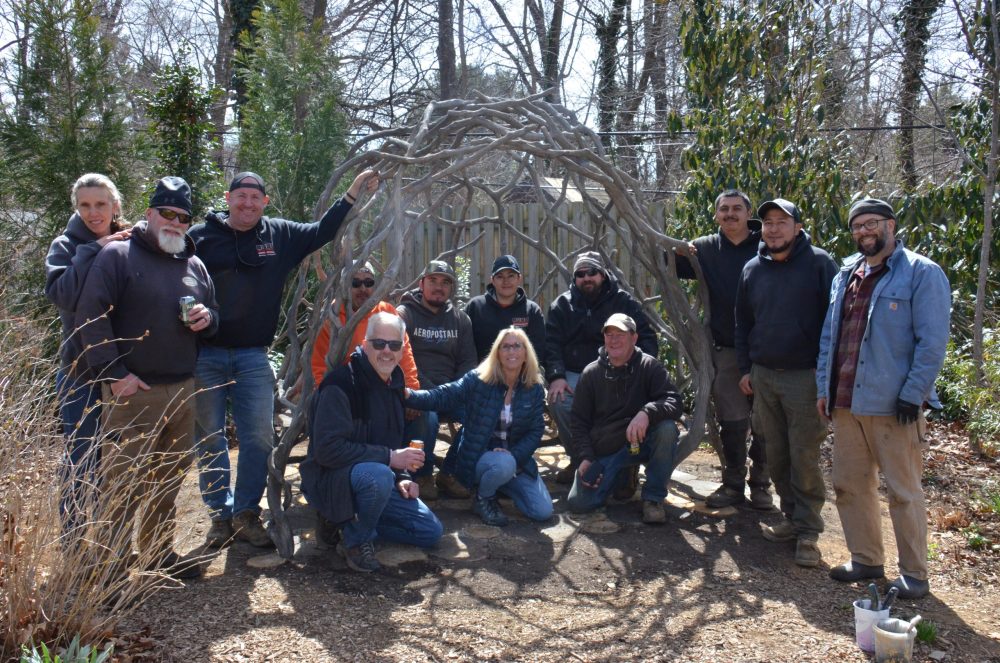
group of people around the sculpture they moved into place
I’m thankful to my village, a group of friends and hired help from CPM Landscaping who safely placed the faux bois ‘Love Shack’ in its new home.
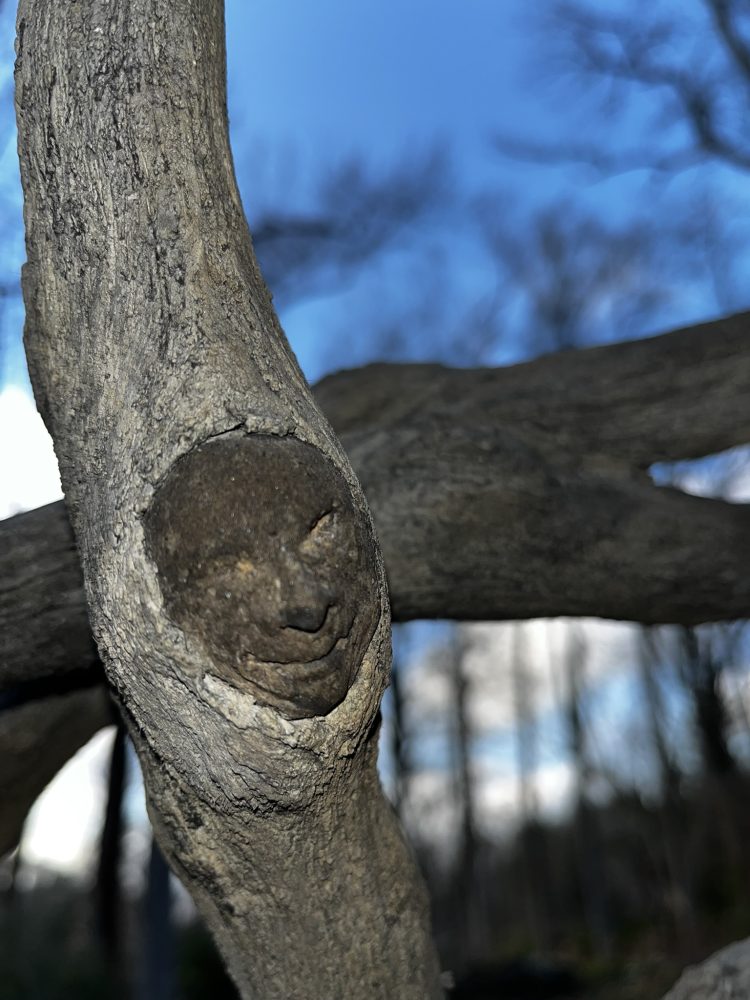
signature face by michael fogg faux bois
If you look carefully when you are sitting in on the bench, you’ll see Michael’s signature face smiling down on you.

Machinery, manpower and ingenuity ensured the new Love Shack made it to its new landing pad where I’m confident I’ll rest easy on its bench knowing I can enjoy my new perch for the rest of my days.

Lasting Landscapes by Carol

Sticks and Stones

I’ve always loved garden accents, whether man-made or natural. Like the plants in someone’s garden, sculptures and other non-plant additions reflect the gardener’s personality and put their stamp on the landscape. In my own garden, naturally occurring boulders not only inspired the name of my garden (Boulder Haven), but also encouraged me to use stone as a primary material for embellishments. In addition to stone, I have also put to use the many branches that have fallen into my garden over the years. Let’s talk about some ways we can use these ‘sticks and stones’ as functional or decorative garden art.

Lasting Landscapes by Carol
This stone wall combines large boulders with slate pieces for an artful display.
Lasting Landscapes by Carol
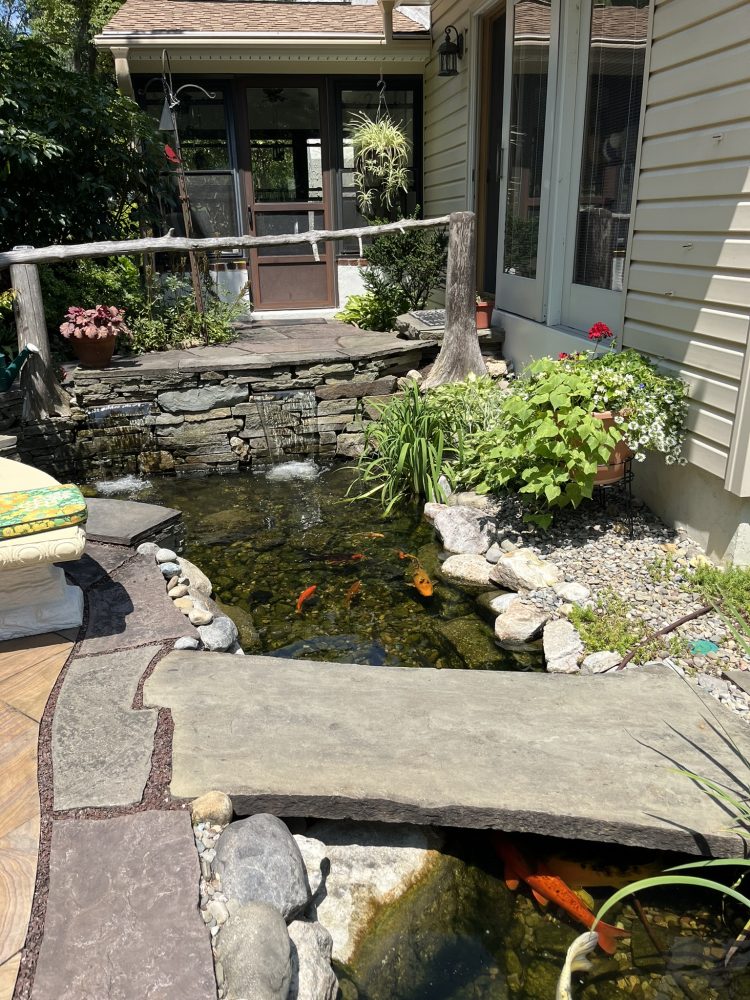
Stone forms a patio, bridge and wall while driftwood pieces serve as a handrail.
Lasting Landscapes by Carol
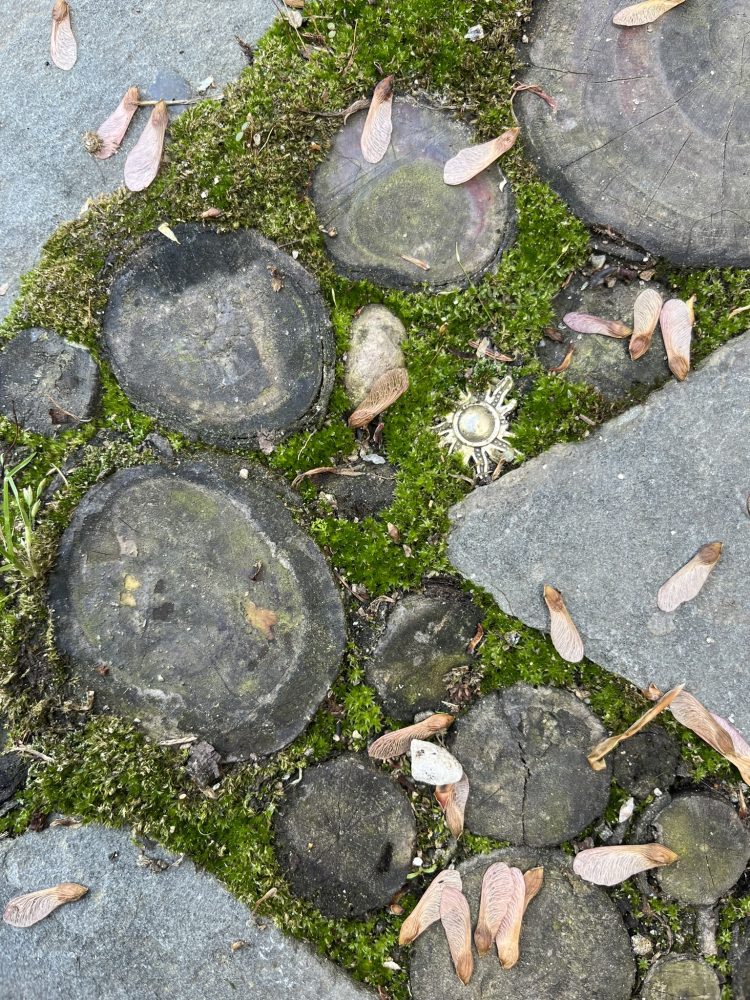
My artist friend Melissa used pieces of wood in combination with slate and meaningful ornaments to create a stunning patio floor.
Lasting Landscapes by Carol
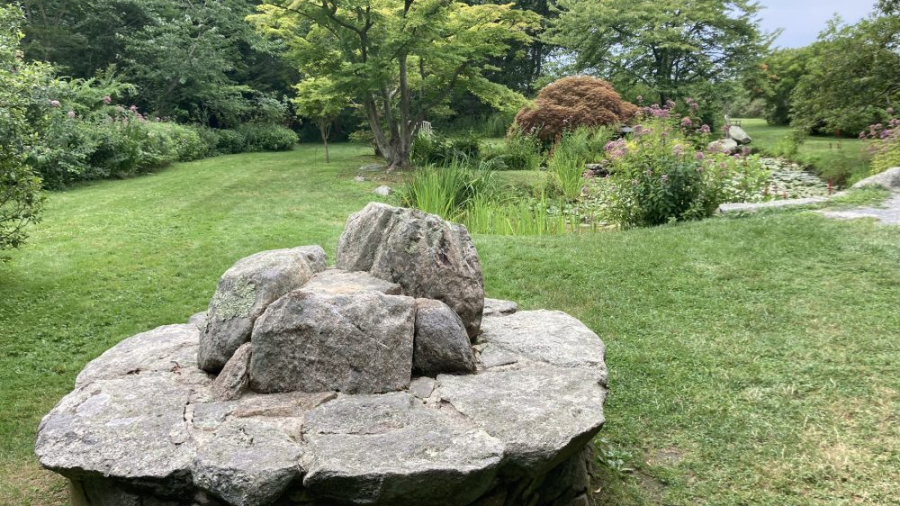
This stone sculpture offers the perfect counterpoint to the planting bed beyond and provides a perch from which to enjoy the garden.
Lasting Landscapes by Carol
A nearby cemetery makes use of broken monuments and natural stone for an interesting rock garden display.
Lasting Landscapes by Carol
A newly installed stone bench at Boulder Haven complements the surroundings and serves as a permanent sitting area.
Lasting Landscapes by Carol
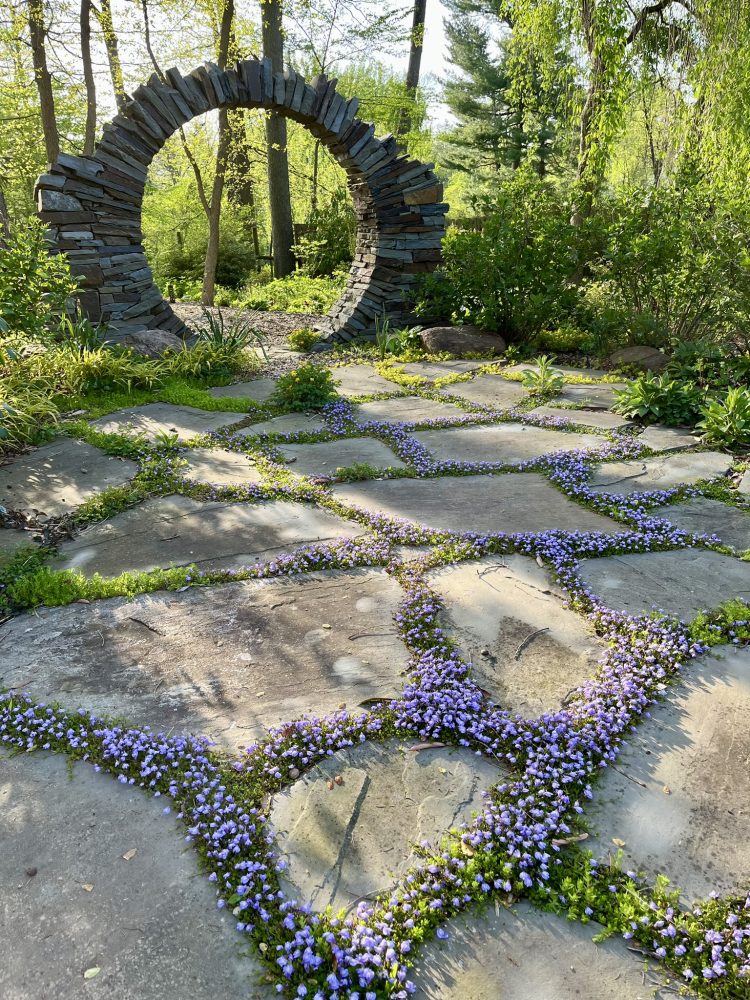
One of the first stone sculptures I added to my landscape was this moon gate flanked with irregular flagstone.
Lasting Landscapes by Carol
In Tenerife, I was enthralled with use of a large stone as the support for a metal handrail.
Lasting Landscapes by Carol
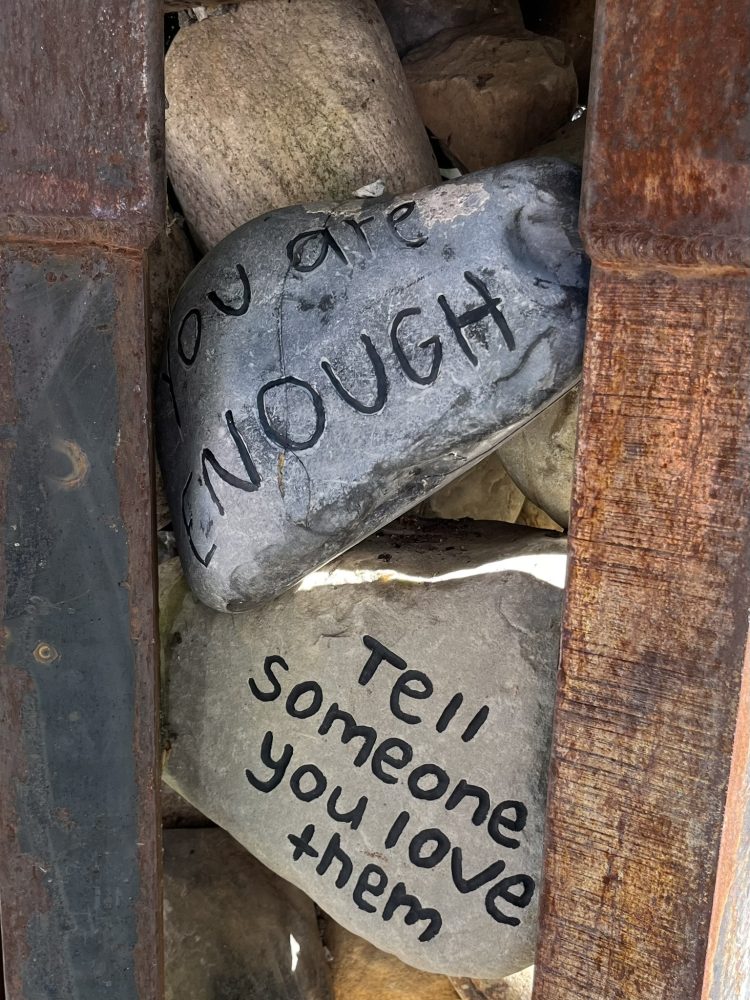
A public garden in North Carolina included an interactive stone sculpture where visitors could write messages on stones and leave them behind to inspire others.
Lasting Landscapes by Carol
A combination of stone and logs formed this fence at Sakonnet Garden in Rhode Island.
Lasting Landscapes by Carol
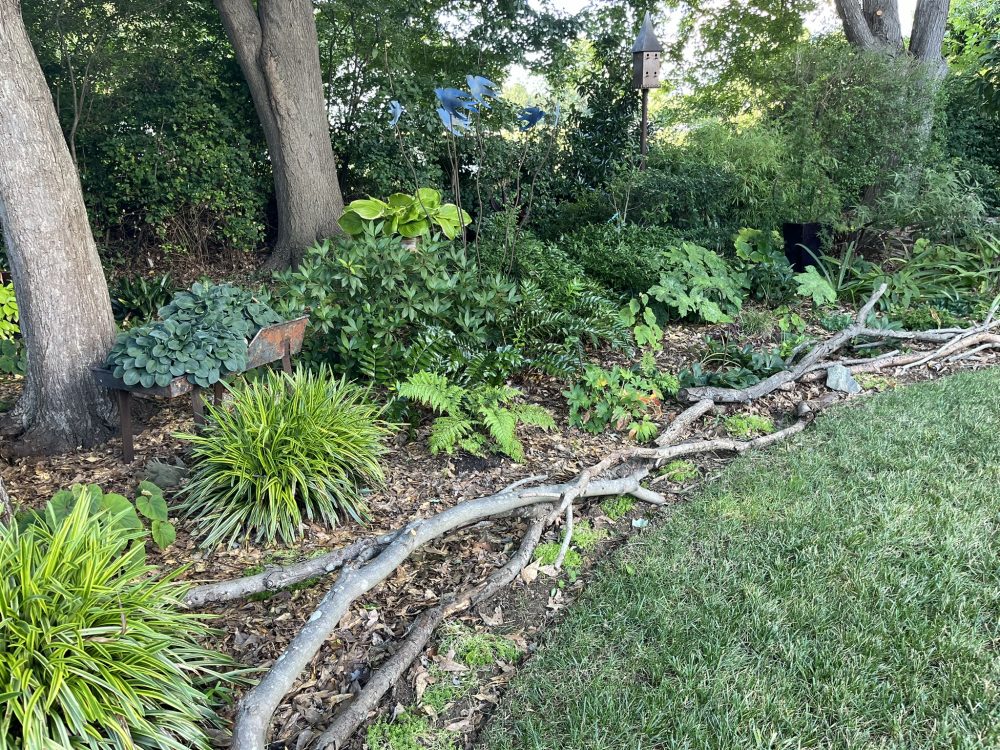
Branches make a practical and lovely edge to a garden bed.
Lasting Landscapes by Carol
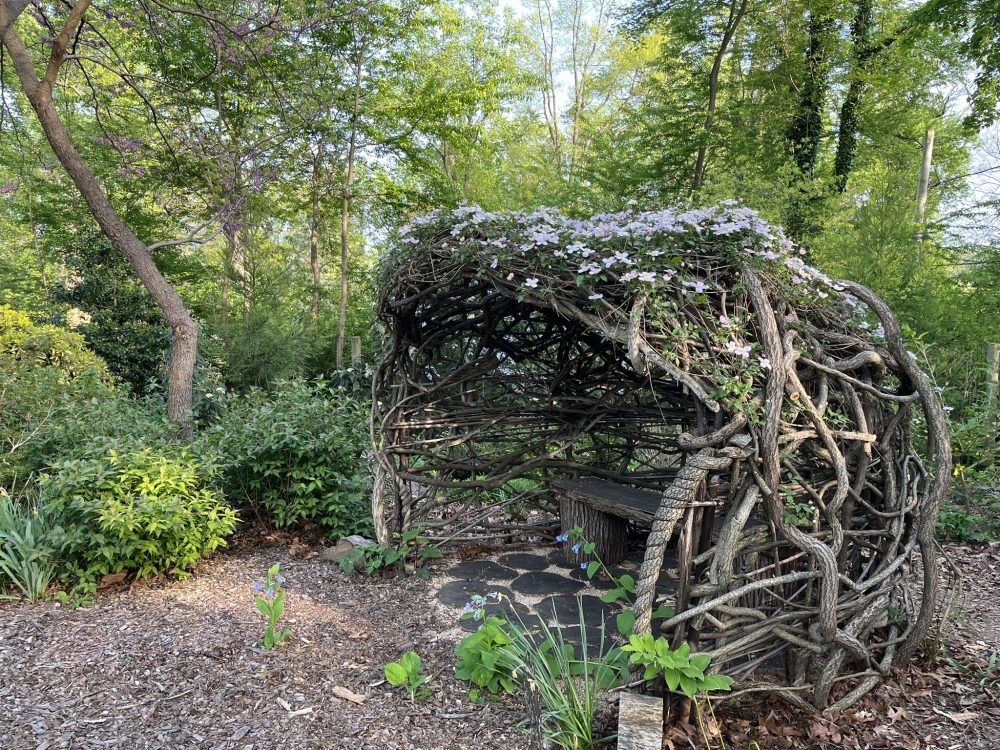
Harvested invasive vines form this structure and provide a support for Clematis montana.
Lasting Landscapes by Carol
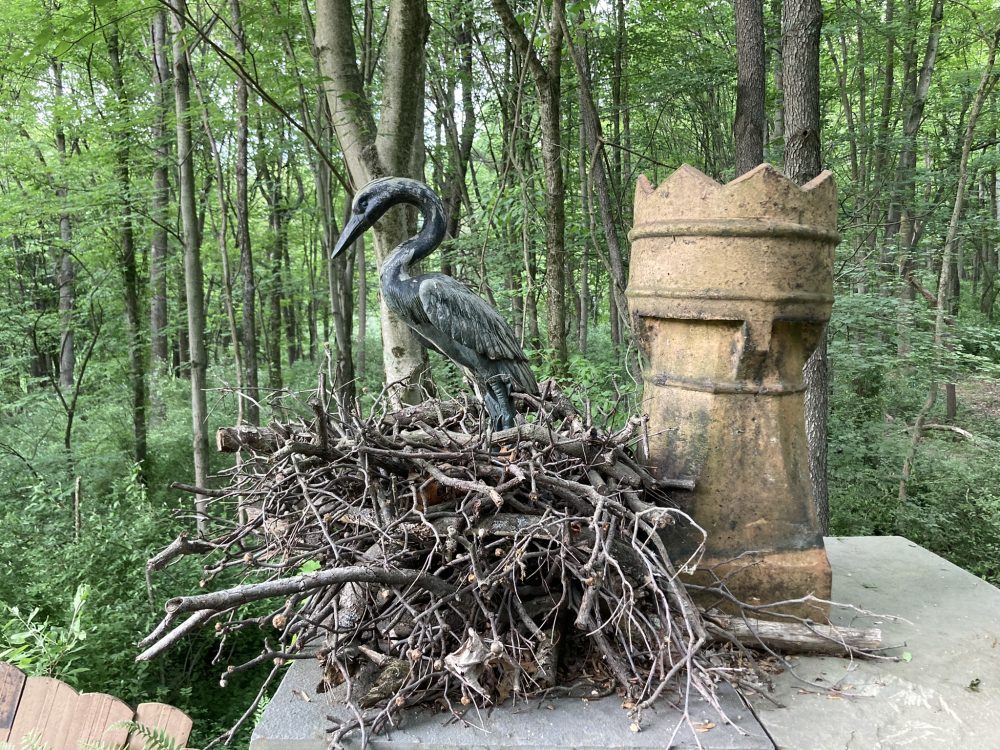
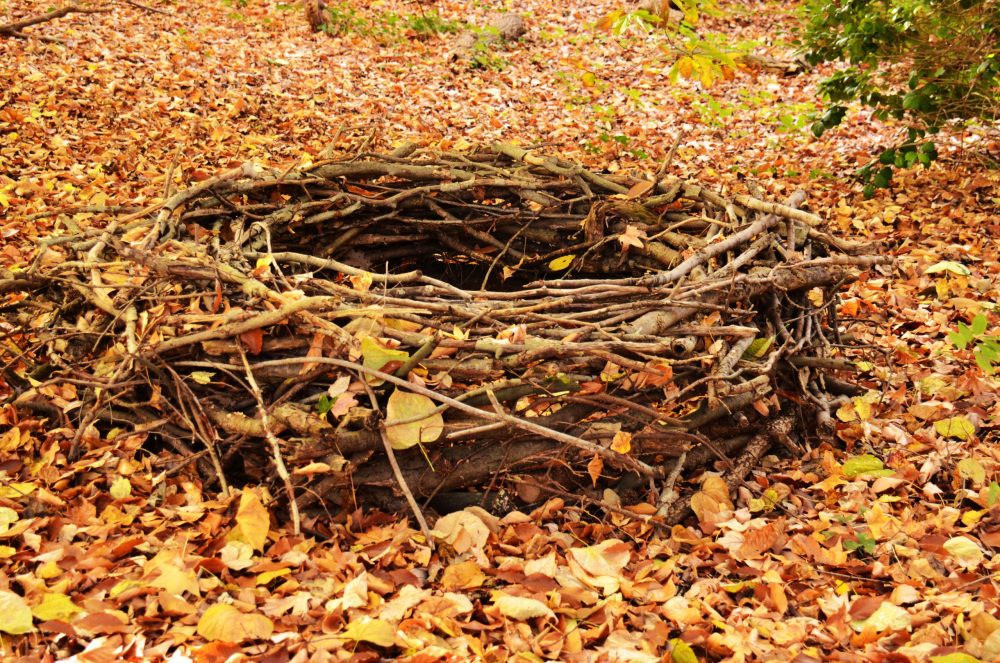
The next time you are picking up sticks in the yard, think about creative ways to use them. In this space, the gathered twigs form a nest for the heron sculpture.
Lasting Landscapes by Carol
Another great way to use twigs is to gather them into different shapes where they can decompose naturally while adding interest to the garden.

When adding art to the garden, think about how the form of the object or structure complements the surrounding area. Place objects where they can serve a function, like a gate, wall or bench or considering using them as focal points to draw visitors’ eyes or guide them through your garden. I hope you’ll decorate your garden in a way that is pleasing to you and that reflects your personality. Fingers crossed that I’ve inspired you to include some sticks and stones in your landscape in new and unique ways.


Lasting Landscapes by Carol

Letting go

I’ve always loved the saying, “Autumn shows us how beautiful it is to let things go.” Sometimes it’s easy to let things go. I have no problem pulling out a plant that’s under-performing or one that has died. Other times it’s an incredibly difficult challenge. This fall I had to let go of a beloved Rhododendron hybrid that has been on the property since I purchased my home 22 years ago. While the blooms of my Rhododendron were nice, I adored the structure of the shrub most. This particular plant had a low branch that reached out like an outstretched arm over the back side of the water feature. I think the birds loved this branch as much as I did. They often perched there to dry off after a bath or waited there for their turn in the upper basin.

Lasting Landscapes by Carol
The outstretched arm of my hybrid Rhododendron on the back side of the water feature

Earlier this year I noticed the plant was in decline. My beloved branch was barely hanging on as interior rot limited the flow of nutrients. I made the decision to remove the shrub. I could have taken the debris to a local compost site or run the remnants through my chipper/shredder. Instead, I decided to repurpose the shrub into some temporary, decorative components in my garden.

lasting landscapes by carol
Removing the branches one at a time
lasting landscapes by carol
The shrub reduced to its bare structure

The branch I loved so much became a guard rail of sorts on the path behind my water feature. In its new home, the branch still serves as a perch for nearby birds and critters. The rest of the shrub was turned upside down into a sculpture. Now it frames the water feature in a different way. This new garden element needs a topper which I’ve yet to discover. I’m open to reader ideas on what would look best.

lasting landscapes by carol
The beloved branch transformed on the side of the path
lasting landscapes by carol
Assessing the new shape

In the spot where the Rhododendron lived for many years, I planted a Chamaecyparis obtusa ‘Compacta.’ While small in stature now, I’m confident this new addition will settle in and grow into a stately backdrop for the water feature and a habitat for my feathered friends.

lasting landscapes by carol
The new Rhododendron ‘sculpture’ next to the Chamaecyparis.

The next time you have to let go of something you love, do your best to embrace the change and the results. Like me, you might find joy in the transformation.

Lasting Landscapes by Carol

Over the Moon

‘People travel the world over to visit untouched places of natural beauty, yet modern gardens pay little heed to the simplicity and beauty of these environments, those special places we must preserve and protect, each in his own way before they are lost forever.’                                                                                                                                                                                                                                    Mary Reynolds

I adore the garden movie Dare to Be Wild. The film tells the story of Mary Reynolds, an Irish landscape designer and youngest winner of a Gold Medal at the Chelsea Flower Show in 2002. Mary’s exhibit encouraged visitors to reconnect with wild nature and featured a moon gate leading down a path to four stone thrones surrounding a fire pit over water.

Lasting Landscapes by Carol
Mary Reynold’s moon gate at the Chelsea Flower Show
Lasting Landscapes by Carol
Mary built an exhibit with thrones and a fire pit

Mary’s exhibit inspired me. The moon gate, which her character in the movie describes as a transition from the natural to the spiritual world, blew my mind. Popular in many cultures, moon gates originated in China, serving as inviting entrances to upper class gardens. Bermudians have featured moon gates in their architecture since the late 19th century.

I am happy to report that Chester County, PA now features a moon gate and it’s installed in my back yard where it marks the entrance to my woodland garden and replaces a temporary arch made of twigs. I adore the symbolism of the moon gate and am thankful I was able to find a talented mason willing to make my vision a reality.

Lasting Landscapes by Carol
My moon gate invites visitors to explore nature on the woodland trail

Scott of KM Gardens had never built a moon gate before but was excited to take on this ‘once in a lifetime’ challenge. Scott researched construction techniques and procured the perfect Pennsylvania fieldstone to integrate with existing boulders on my property.

Lasting Landscapes by Carol
Rocks delivered and the template in place
Lasting Landscapes by Carol
The initial moon gate under construction

Scott began work in September. After a week of stone chiseling and stacking, we were excited for the unveiling. Poised in front of the structure, I began to videotape the reveal as the wooden frame was slowly removed. Unfortunately, the first attempt wasn’t successful and the grand structure collapsed before our eyes. Fortunately, no one was hurt physically. Pardon the expletives as you watched the video. As you can imagine we were shocked and disappointed!


Scott, a true craftsman, regrouped after this disappointment, revisited tutorials on construction and started over the next morning, making multiple adjustments including the angle of the stones and the addition of mortar to keep the stabilizing sides from moving. Version two was a success!

Lasting Landscapes by Carol
Starting over with the wooden form
Lasting Landscapes by Carol
Angling the stones to ensure proper weight distribution
Lasting Landscapes by Carol
Scott and team with the finished moon gate

Now I’m inspiring friends with my moon gate, which has been described as gorgeous, stunning, awesome, beautiful and the coolest thing ever! I agree on all fronts and am thrilled to enjoy it as an amazing architectural accent to my landscape.

Stunning from all sides moon gate
Beautiful from all sides

I’m pretty sure Scott’s once in a lifetime project is going to become a series of moon gates as I expect others to request his services. And I’ll continue to share Mary Reynold’s story and encourage others to invite wild nature into their own gardens.

Lasting Landscapes by Carol

On the Road Again

I love visiting gardens and seek out every opportunity I have to wander through public and private spaces. During a recent road trip through Pennsylvania, Ohio, Indiana and Michigan I gained inspiration from many different landscapes. I realized there are often many take-aways from visiting other gardens which can easily be applied to your own oasis.

Light the way

Most of us are busy. I can probably count on one hand the number of times I’m actually able to relax in my garden and absorb its beauty. By adding interesting lighting to your outdoor space, you can extend the time spent in your garden and further your enjoyment of it. This becomes especially important as days become shorter. Plus, lighting adds an incredible ambience and can enhance your viewing of plant material.

Lasting Landscapes by Carol
Woven wooden lighting in the Phipps Conservatory
Lasting Landscapes by Carol
Interesting lighting in the Cuba exhibit at Phipps Conservatory

Add Whimsy

Who doesn’t enjoy laughing? After all, it is one of the best medicines (or so they say). The Hidden Life of Trolls exhibit at the Phipps Conservatory in Pittsburgh made me laugh out loud. Think about ways you can add the unexpected to your landscape and cause a garden visitor to smile as they take in the scenery.

Lasting Landscapes by Carol
A troll made entirely of plant material at the Phipps Conservatory
Lasting Landscapes by Carol
More troll whimsy at Phipps

Incorporate Sculpture

Some gardens are dedicated to sculpture like the Grounds for Sculpture in New Jersey and the Frederik Meijer Gardens & Sculpture Park in Grand Rapids, Michigan. I believe every garden is enhanced by the addition of a sculpture to create a focal point or invite someone to a certain part of the garden.

Lasting Landscapes by Carol
A modern sculpture in Grand Rapids, MI at the Frederik Meijer Garden
Lasting Landscapes by Carol
Horseshoes became butterflies in Holland, MI
Lasting Landscapes by Carol
Sculpture in the Phipps Conservatory
Lasting Landscapes by Carol
Glass flowers seem right at home among live plants
Lasting Landscapes by Carol
Another glass sculpture creates a magical space

Use Unconventional Containers

When looking for a container, don’t always choose the obvious vessel. There are many different objects that make great and interesting containers such as galvanized buckets or even Dutch wooden shoes!

Lasting Landscapes by Carol
An old bucket makes a perfect container for succulents
Lasting Landscapes by Carol
Have some old shoes? Why not use them as planters!

There is no shame in using someone else’s ideas in your own garden. Go ahead and add some light, whimsy, sculpture or unique containers to your landscape. Then enjoy your additions and reflect on your travels and the spaces that inspired them.

IMG_20190624_062752

Rising from the ashes

When I first bought my property nearly 19 years ago, I was thrilled with the woodland setting and adored my many deciduous trees. But then I was made aware of the ash borer, an uninvited pest from Asia, and I became distraught over the 24 ash trees on my property and their pending demise if left untreated.

I consulted an arborist and together we determined it made sense to protect 10 of the trees with regular injections, while removing the rest. Over the last several years I have been removing trees. Some of the ash trees I removed were quite large, which meant I had a lot of ash wood to deal with and that’s where I had to get creative.

Cherished bowls made from ash trees on my property

With the first batch of ash trees removed, I asked Carlos Soler, a family friend and amazing woodworker to make wooden bowls for me with some of the remnants. Carlos did an amazing job and I cherish the bowls for their beauty, function and remembrance. You can find other artistic treasures made by Carlos by visiting his site on Etsy https://www.etsy.com/shop/CSWoodworks1?ref=search_shop_redirect.

Of course I saved some of the wood for firewood and gave a bunch to friends for the same purpose. But I quickly realized only a certain amount of firewood could be used in a reasonable time without most of it rotting. I still had a lot of wood to manage.

During a visit to Cape Cod a couple of years ago, I saw an amazing natural arbor at a local botanic garden. I showed the photos of the arbor to local chain saw artist Marty Long who was able to translate my vision into reality with collected branches.

An arch made from branches marks the entrance to the woods

In addition to my arch, which now marks the entrance to my woodland trail and invites guests to meander, Marty made a bench for me which I enjoy regularly. Yes, I actually do sit down from time to time – hurray! My new bench provides a great vantage point of the water feature and the woodland trail and gives my friends and me a place to pause, relax and enjoy.

An ash tree transformed into a bench

The last thing I have done with my ash trees is to leave some of them standing about 20 feet tall. This way they are not a hazard to garden visitors, can easily be taken down from the ground if they become a concern, and can benefit wildlife as they decay. Plus, it’s less expensive to take down a tree partially instead of completely!

Trees left standing

My point is, when life gives you lemons, or an invasive pest like the ash borer, you need to find a way to make lemonade. If you have ash trees that need to be removed, let me know how you are dealing with the issue. I am confident if you look hard enough, you’ll find the silver lining and ways to use that wood that enhances the beauty of your garden, provides ecological benefits and more.


blue bird on house lasting landscapes by carol

Problem Solved

As a landscape artist I am often challenged to solve problems. I welcome the opportunity since I have always loved puzzles. One challenge presented to me was to hide a utility pipe near the driveway. The pipe was one of the first things you saw when you approached the home and that was not very welcoming. You might think solving this problem was easy, but it wasn’t. There was very little space in front of the pipe so planting an evergreen to screen the view wasn’t an option. Also, access to the pipe was critical. The solution? A lovely millstone that enhanced the view, yet could be rolled out of the way when access was required. And I bet you thought the solution was going to be a plant!

Lasting Landscapes by Carol Before and After
Utility pipe before being disguised
Lasting Landscapes by Carol before and after
Utility pipe with millstone in place

A different challenge existed at a client site where a landscape bed needed a retaining wall of sorts and some definition. The answer here was to add art to the garden in the form of a natural fence. The best part of this solution was that it was free. Next time you are cursing the fallen branches in your yard, think differently. Likely, you can repurpose them into something beautiful and useful. What better way to recycle natural materials.

Lasting Landscapes by Carol
A natural fence made of branches

“Junk” can be repurposed too. A talented friend of mine, Eric Sternfels, is an expert at repurposing materials into garden art. Not only do his vignettes add charm, character and focal points to the garden, but they are budget friendly too.

Lasting Landscapes by Carol
Chairs used as planters – genius!
A pedestal combined with a pot of pansies makes for a joyful display
Don’t you want to be invited to this tea party?

I borrowed that line of thinking from Eric and recently had some birdhouses made with license plate roofs. If I hadn’t used the license plates, they likely would have made their way to the junkyard.

The bluebirds are enjoying the new bird house

If you have a pile of items ready to be donated to charity, evaluate how they might be repurposed before you give them away. You might just find a unique use for something, while enhancing your garden space.